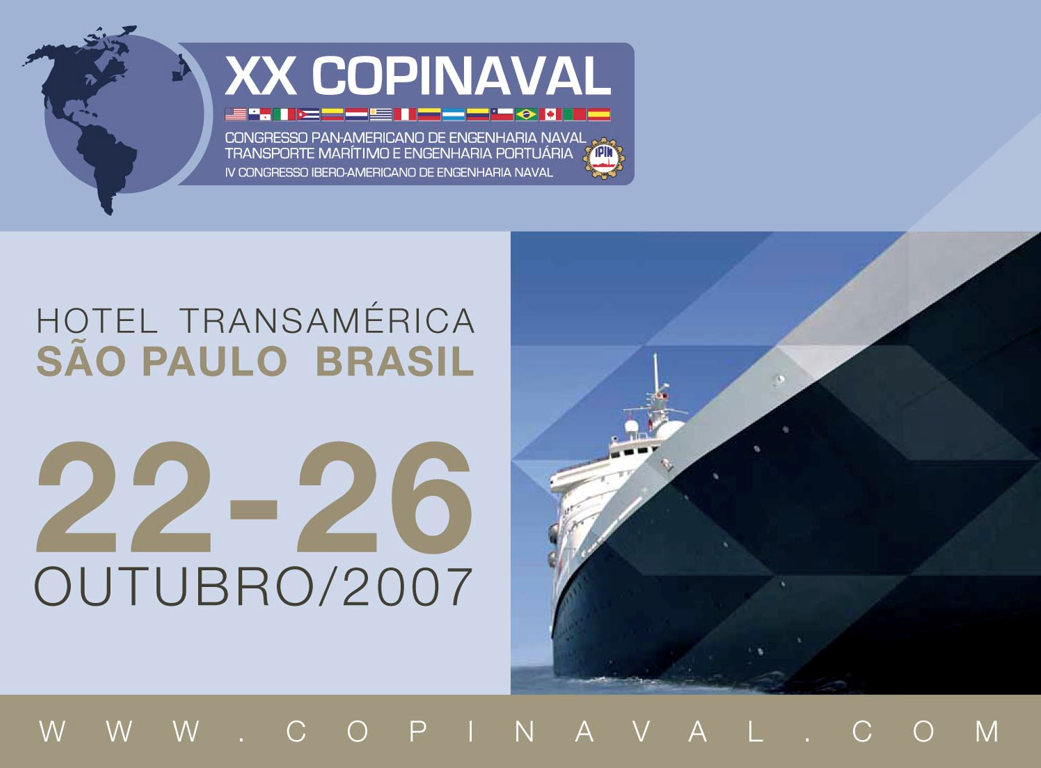
It was one of the most important technical and scientific conferences in the maritime and naval sector in Latin America in 2007. The conference took place from October 22 to 26, 2007, at the Transamérica Hotel in São Paulo, Brazil, and was organized by the Pan-American Institute of Naval Engineering (IPIN) and the Department of Naval and Ocean Engineering at the University of São Paulo (USP), under the chairmanship of Professor Rui Carlos Botter.
The event had a Pan-American focus and brought together naval engineers, port engineers, specialists in maritime transport, logistics, shipbuilding, and ocean engineering, as well as representatives from academic institutions, governments, navies, and private companies from Latin America, the United States, Portugal, and Spain. Its main objective was to promote the exchange of scientific and technological knowledge, the presentation of technical research, and discussion of the operational, economic, and political challenges facing the maritime-port sector.
The 20th COPINAVAL coincided with a strategic period for the Brazilian naval industry. At that time, Brazil was undergoing a phase of revitalization and modernization of the shipbuilding sector driven by the Growth Acceleration Program (PAC), promoted by the federal government, which called for the construction of 42 new vessels by domestic companies and sought to reestablish the Brazilian shipbuilding industry among the world’s leading ones. In this context, the conference became a vital forum for discussing the country’s production capacity, new market opportunities, and technological developments applied to maritime transport and port infrastructure.
The conference featured a robust organizational and scientific structure comprising specialists from various countries. Participants included representatives from universities, technology centers, and international organizations, as well as professionals from the naval and offshore industries. Among the members of the scientific committee were experts from institutions such as the Federal University of Rio de Janeiro (UFRJ), the Institute for Technological Research (IPT), Petrobras, and IPIN itself, with representatives from countries including Panama, Cuba, Colombia, Mexico, and Chile.
The event received approximately 250 scientific abstracts for evaluation. Following a technical review process conducted by specialists, 141 scientific papers were selected and published in the conference’s official proceedings. The research covered various areas of naval and maritime engineering, including shipbuilding, hydrodynamics, maritime logistics, ports, river transport, offshore structures, maritime safety, computational simulation, naval maintenance, and military projects. In addition to the technical sessions, seven keynote lectures were delivered by renowned specialists in the field.
In parallel with the 20th COPINAVAL, important complementary events took place. One of these was the 4th Ibero-American Congress of Naval Engineers, which strengthened academic and professional cooperation among Latin America, Portugal, and Spain. The 9th SYMMEDUC—Symposium on Naval Engineering Education—was also held, where discussions began on the creation of a unified curriculum for the training of naval engineers in Latin America. Another highly significant event was the 10th SYMMISSEL—Pan-American Symposium on Military Ship Design and Construction, organized by the Brazilian Navy, which brought together specialists in naval military technology, armaments, and maritime logistics.
One of the innovative aspects of the conference was the first Pan-American scientific research competition for university students in their final years of naval engineering-related degree programs. Each participating country presented a paper defended by the student author. Chile’s representative took first place, followed by Brazil and Colombia, thereby strengthening academic integration and encouraging scientific research among young engineers.
The 20th COPINAVAL also included external technical activities and professional visits. Participants visited the Port of Santos, considered the largest port in Latin America, as well as maritime terminals, shipyards, and specialized technology centers. Notable visits included the Wilson Sons shipyard, the Santos Brasil and T-37 terminals, as well as the Institute for Technological Research (IPT) and centers involved in the development of Brazil’s nuclear submarine.
Held in conjunction with the conference was MARINEXPO, an international trade show that brought together shipping companies, shipyards, port terminals, marine equipment manufacturers, classification societies, universities, and research centers. The main objective of the fair was to promote commercial relations, technological exchange, and integration between supply and demand in the maritime sector. Among the participating institutions and companies were Transpetro, the American Bureau of Shipping, Damen Shipyards, Germanischer Lloyd, CMA CGM, and various academic and technological organizations.
Military participation was also significant. The Brazilian Navy (Marinha do Brasil) and Emgepron had a prominent presence, along with naval delegations from Colombia, Chile, Peru, and Argentina. More than 30 foreign military personnel participated in the conference’s technical and strategic activities, reinforcing the event’s international and geopolitical dimensions.
In terms of statistics, the event brought together more than 1,000 participants, including conference attendees, exhibitors, speakers, members of the press, and trade show visitors. Approximately 714 people participated directly in the conference and the naval management workshop, while the MARINEXPO trade show welcomed approximately 1,070 participants. Brazil had the largest representation, followed by delegations from Chile, Ecuador, Spain, Peru, Cuba, and other American and European countries.
Finally, the 20th COPINAVAL reaffirmed the historic role of the Pan-American Institute of Naval Engineering, founded in 1966 with the support of international maritime organizations and the Brazilian Navy. Since its inception, the conference has established itself as one of the leading Pan-American forums dedicated to the scientific, technological, and strategic development of naval engineering, maritime transport, and port engineering on the continent.
Photo Gallery of Technical Presentations
For more information, please email:
soporte@copinaval.com
© 2025 Copinaval. All rights reserved.
WhatsApp us